
Source: http://vasat.icrisat.org/crops/pearl_millet/pm_production/html/m3/index.html
Area and Distribution of Pearl Millet
Pearl millet is one of the most extensively cultivated cereals in the world, after rice, wheat, and sorghum, and particularly in arid to semi-arid regions.
| Crop | Area (Millionha) | Production(Million MT) |
| Wheat | 216 | 626 |
| Rice | 154 | 615 |
| Maize | 147 | 692 |
| Barley | 57 | 138 |
| Sorghum | 43 | 57 |
| Millet | 27 | 36 |
World Area and Production of Major Grain Crops during 2005
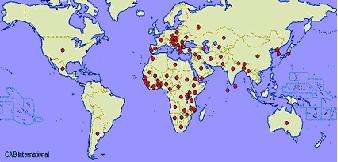
Millet Growing Areas in the World
Area and production of pearl millet in the world is combined with other millet crops like finger millet, foxtail millet etc. So, data are not available for pearl millet crop alone. However, pearl millet accounts for almost half of global millet production.
60% of world millet area is in Africa. Asian countries occupy 35% of world millet area. European countries cover 4% of millet area and 1% is in North America.
The developing countries in Asia and Africa contribute around 93% of total millet production in the world. Asia alone contributes 43% of world millet production. European countries produce 6% and 1% is in North America.
Millet cultivating areas in Asia
| Country | Area in 000 ha | Production in 000mt |
| China | 1100 | 2200 |
| India | 9800 | 9400 |
| Myanmar | 215 | 150 |
| Nepal | 258 | 283 |
| Pakistan | 343 | 193 |
In Asia, millet is restricted almost exclusively to two countries, China and India, although Myanmar, Pakistan, and Nepal also produce small quantities. In China the major millet crop is foxtail millet.
Pearl Millet cultivating areas in India
India is the largest producer of this crop, both in terms of area (9.1 m ha) and production (7.3 m t), with an average productivity of 780 kg/ha during the last five years. As compared to the early 1980s, the pearl millet area in India declined by 26% during the last five years, but production increased by 19% owing to a 44% increase in productivity.

Three-year moving average for pearl millet area, production, and grain yield; and number of varieties (3-year total) based on ICRISAT-bred material in India.
Major pearl millet growing States are:
| State | % Share Of All India Area |
| Rajasthan | 51.0 |
| Maharashtra | 15.3 |
| Gujarat | 10.6 |
| Uttar Pradesh | 9.2 |
| Haryana | 6.2 |
| Karnataka | 3.0 |
| Madhya Pradesh | 1.9 |
| Tamil nadu | 1.4 |
| Andhra Pradesh | 1.1 |
The productivity of Pearl millet
| State | Productivity (kg/ha) |
| Haryana | 1331 |
| Gujarat | 1277 |
|
Uttar Pradesh |
1235 |
| Madhya Pradesh | 1150 |
| Tamil nadu | 1144 |
| Andhra Pradesh | 872 |
| Rajasthan | 788 |
| Maharashtra | 673 |
| Karnataka | 532 |
Pearl millet cultivation is dispersed mainly during Kharif (Rainy) season across the country. It is also grown to a lesser extent during Rabi (Post-rainy) season in Andhra Pradesh , Karnataka, Tamil Nadu and Pond cherry States. Summer pearl millet is popular in Gujarat State with very high yield exceeding 1.88 tons per ha with excellent grain quality. It is also grown during Summer season in Punjab, Rajasthan and Attain India, the yield of pearl millet varies from sate to state with varying rainfall and soil type, and also between seasons. The productivity imbalance in pearl millet is due to no rain/erratic rains/shifting of Pearl millet cultivation to marginal soils due to diversification of traditional area to high value crops across the country. Only about 8% of pearl millet area is irrigated.
Area. Production and Yield of Pearl Millet in different states of India during 2002-03
| State | Area(Million ha) | Production(Million Tones) | Yield(kg/ha) | IrrigatedArea (%) |
| Maharahtra | 1.55 | 20.4 | 741 | 5 |
| Gujarat | 0.94 | 12.4 | 965 | 18 |
| Uttar Pradesh | 0.7 | 9.2 | 1277 | 5 |
| Rajasthan | 3.2 | 42.1 | 224 | 5 |
| Haryana | 0.52 | 6.8 | 893 | 24 |
| Tamil nadu | 0.12 | 1.6 | 1348 | 12 |
| Karnataka | 0.31 | 4.1 | 459 | 9 |
| Madhya Pradesh | 0.15 | 1.9 | 758 | 0.1 |
| Andhra Pradesh | 0.09 | 1.2 | 711 | 22 |
| Jammu & Kashmir | 0.01 | 0.2 | 597 | 0.8 |
Production constraints
-
Cultivation on marginal lands;
-
Unreliable rainfall tends to keep the use of inputs such as fertilizers to a minimum;
-
Loss of crop due to downy mildew and bird damage;
-
Limited commercial demand depress the incentive to use purchased inputs.
- Login to post comments
- 31349 reads