
Management strategies for Chilli thrips (Scirtothrips dorsalis)
The chilli thrips, Scirtothrips dorsalis Hood, is an important pest of various vegetable, ornamental and fruit crops in southern and eastern Asia, Africa, and Oceania. Characterisd by relatively short life cycles, the pest can complete several generations on a crop. Adults and nymphs of these insects suck sap from tender leaves and growing shoots. Affected leaves curl upwards and downwards resulting in damage called ‘chilli leaf curl.’
Damage: Chilli Thrips prefer young leaves, buds, and fruit. Typically axillary leaf branches tend to be the most damaged. Common damage includes browning, bronzing or blackening of infested plant parts, stains and scars may also occur. Severe infestations may result in deformation, leaf distortion, defoliation, stunting, and dwarfing. Feeding may cause buds to become brittle and drop.
Chilli Thrips possess piercing and sucking mouthparts and cause damage by extracting the contents of individual epidermal cells leading to necrosis of tissue. This changes the tissue color from silvery to brown or black. Chilli Thrips create damaging feeding scars, distortions of leaves, and discolorations of buds, flowers, and young fruits by feeding on the meristems of the host plant's terminals and on other tender parts above the soil surface. A severe infestation of chilli thrips makes the tender leaves and buds brittle, resulting in complete defoliation and total crop loss.
Identification of the pest
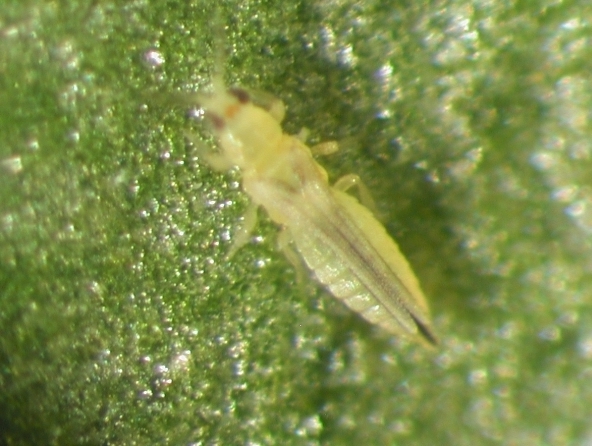
- Nymphs: Tiny, slender, fragile and straw yellow in colour
- Adult: with heavily fringed wings
Management
- Inter crop with agathi Sesbania grandiflora to provide shade which regulate the thrips population
- Do not grow chilli after sorghum – more susceptible to thrips
- Do not follow chilli and onion mixed crop – both the crops attacked by thrips
- Sprinkle water over the seedlings to check the multiplication of thrips
- Treat seeds with imidacloprid 70% WS @ 12 g /kg of seed
- Apply carbofuran 3% G @ 33 kg /ha or phorate 10 % G @ 10 kg/ha or spray any one of the following insecticide viz., Thiacloprid 21.7 % SC @6.0 ml/10 lit.; Imidacloprid 17.8 % SL @ 3.0 ml/10 lit. ; Dimethoate 30 % EC @1.0 ml/lit. ;Emamectin benzoate 5 % SG @ 4 g/10 lit.; Fipronil 5 % SC @1.5 ml/lit.; Oxydemeton –Methyl 25 % EC @1.0 ml/lit.
- Login to post comments
- 9807 reads