
Pre-Reqisites for site selection for construction of fish farm
- Different types of pond are required for rearing various stages of fish.
- Good quality water retentive soil base and assured adequate water supply throughout the year is required for constructing various kinds of ponds.
- Topography should facilitate self- drainage of ponds.
1. Topography
- Topography / layout of land are the surface feature of water shed.
- Topography influences the type of farm.
- In a valley, basin is surrounded on three sides with high lands and a narrow outlet on the forth.
- In gently sloping land, self drainable ponds can be constructed on higher elevation.
- In swampy and marshy areas, bunds constructed by depositing earth, to cordon off ponds of required sizes.
- Barrage type ponds are made by building a series of dams in a narrow flowing stream.
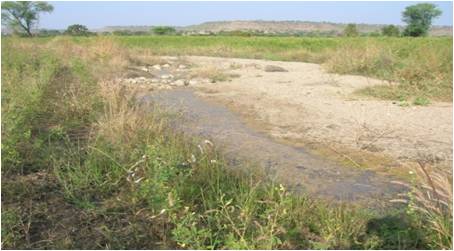
Site for construction of fish farm
2. Soil type
- The soil should be free from vertical and lateral seepage
- Impervious soils store water for long periods and loss of water mainly from evaporation.
- Impervious soils are poor in heavy clay, clay loam, silty clay, etc.
- Bottoms of porous soil can be treated with bentonite, clay or other sealants. Even cow dung acts as a sealant.
- The degree of porosity determines the requirement of additional water to maintain the required level.
- Sites with rocky out-crops, shale ledges, sand, gravel and limestone areas are not suitable.
- Sprayed on asphalt liners and plastic film liners can also be used and covered with layer of soil in permeable soils.
- The sealing material should be sprayed uniformly over the pond bottom in two or three layers, spreading in different direction ensure uniformity of coverage. Then it is disked into the soil and compacted by roller.
- Embankment base should be well scarified in preparation for fills. This will allow the embankment to knit in to the ground.
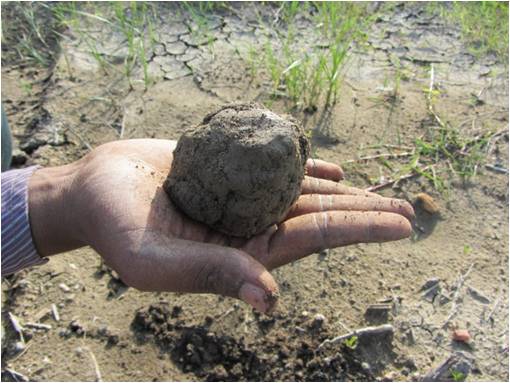
- A simple way to test the water retention soil at the field level is by squeezing a moist chunk of soil into a tight ball. If it does not crumble after some handling or squeezing, it may be regarded as satisfactory.
Soil quality for fish culture
3. Water supply
- Fish depend on water for all their needs.
- Adequate quantity of good quality water must be available throughout the year.
- A dependable source of water supply must be available near the site.
- Usual sources of water supply are: reservoirs, streams, canals, surface run offs, wells, artesian wells, tube wells, etc.
- Water from any sources is suitable for fish culture, provided it is free from contamination.
- Streams and canals are satisfactory source of water for ponds, if the following requirements are met.
- The flow is enough to fill the tanks.
- It maintains a fairly constant water level.
- Stream is not subjected to excessive flooding.
- Watershed is well vegetated.
- Small streams which are subjected to floods during heavy rains should be avoided as they usually carry a considerable amount of silt reducing the fertility of the ponds.
- Springs :
- Spring water is obtained from underground.
- It is a very good source for fish culture.
- It is usually uncontaminated, and does not contain undesirable fishes, fish eggs and pathogens.
- If the water from a spring has travelled very far, it may need to be filtered before it is used for a fish pond.
- Rainfall :
- “Sky ponds” rely only on rainfall to fulfil their need for water.
- For stock ponds, rain water run- off from land is one of the chief sources of water.
- The size of watershed determines the availability of water throughout the year.
- Wells:
- The best source of water for a fish pond is well water.
- Continuous water supply can be obtained from wells.
- Well and spring waters are often low in oxygen content and fish need more oxygen in the water.
- The oxygen can be added to the water by agitating the water in the pond, stirring the water in the pond, by beating the water with bamboo sticks, by running small motors in the pond and by using sprinklers.
- Artesian wells are used for water supply in areas where they confirm to certain geological contours.
- Underground seepage is often used as the water supply for ponds formed in abandoned mining pools, rock quarries, burrow fits, etc.
Requirement of a normal fish farm site under Indian conditions
Particulars
Requirements of a normal fish farm site
Nature of terrain
Non rocky with at least 2m deep soil
Slope of the terrain
Land should be gently sloping or level
Physical quality of soil
Soil fraction should be above 90% of the whole soil, stone and gravel not exceeding 10%
Chemical quality of soil
Neutral pH, total nitrogen >0.1%,
total phosphorous >0.1%,
Organic carbon >1.0%, Free CaCO3>5%.
Rate of fall in water level in ponds
Should be less than1 m per anum
Water table
Should not be far below the pond bottom when the soil is not water retentive
Water supply
There should be a source of perennial water- supply nearby, sufficient to meet the requirement of the farm
Biological productivity
Average plankton production per m3 should range between 10 ml and 20 ml.
- Login to post comments
- 10784 reads